
Krampus Character Design and Modeling Process
Updated: Jul 5, 2023
In my current 3D sculpting class, we were instructed to find a relatively well-known monster or creature to design and model and I chose Krampus. I've always been interested in the lore involved with him and the idea of finally being able to delve into that lore further is pretty exciting for me!

Interestingly enough, while Krampus is a fairly well-known creature, it's unknown exactly where and when he was created. The most popular speculation is that he predates Christianity and originated in the Alpine regions of Europe. His name is thought to be from either (or possibly both) the Bavarian word for dead and rotten (krampn) and the German word for claw (kramp/krampen).

Krampus has many different variations, but many of them share a lot of the same characteristics. He's hairy, has cloven hooves and horns like a goat, brown or black fur, a long tongue that lolls out, and fangs. One of the accessories that he typically carries are chains (meant to represent the binding of the Devil by the Christian church) that sometimes have bells attached to them. They ring when he jangles and thrashes his chains for dramatic effect. He also may carry birch branches to swat children with and a large sack paralleling that of Santa or Saint Nicholas, though he uses it to kidnap children.
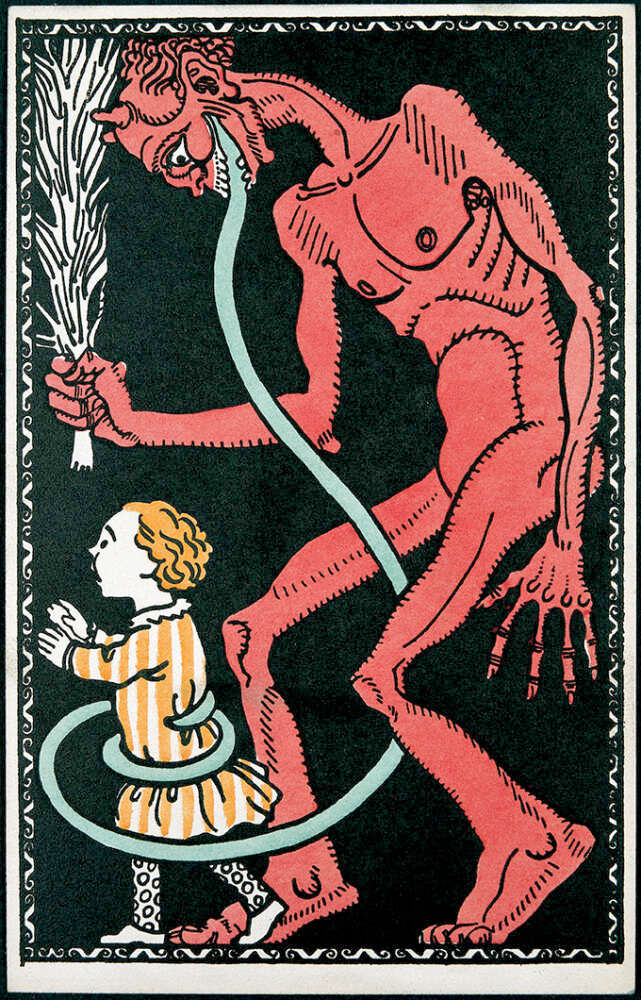
There were also several pagan traditions that predated Catholicism's arrival to the Alpine region that played into a similar thing that Krampus does. One of such traditions was that of Percht, a two-legged humanoid goat with a giraffe neck who wore various animal furs. Similarly to with Krampus, people would masquerade as him and march in processions. The Catholic church, however, wasn't too keen on the Percht and attempted to ban it. Unfortunately for them, it was hard to ban something in such a large swath of Europe. Once Saint Nicholas became an important part of the culture there, Percht turned into Krampus, who is a direct counterpart to Saint Nicholas.

Now that I've done some research, it's far easier to put together a character design for Krampus. There are a few things that I need to take particular note of in this design or else it won't come off as Krampus whatsoever. These things are his goat-like features, long fur, and long tongue. I would like to find a way to incorporate both the chains and the sack (perhaps the sack is strapped onto his back with chains?). In theory I could find a way to incorporate the birch branches, but I feel as though they're not as key to his design. I would also like to find a way to incorporate more of Percht's essence in his design since the two are so closely related. This will probably mean extending Krampus' neck and/or giving him multiple furs to wear. If I wanted to go into slightly darker territory (which I suppose would be fitting for him), these furs could be skinned reindeer or something to that effect. If I were to go that route, I could do something interesting with the reindeer's antlers, such as giving Krampus the appearance of having spines.


Speaking more generally, I believe it's incredibly important to emphasize how dangerous Krampus is. He's a bit of a tricky creature so the easy route would be to make him spindly or incredibly thin (see: characters such as Waluigi). However, I think it's more fitting for him to be on the bigger side. I feel as though he could very well be a lumbering creature with some more rounded features, but I'd need to make sure these features feel incredibly grounded (so possibly more square in nature than oval or circle). The goal here is a feeling of weight and intimidation, not friendliness. Assuming I go the route of having reindeer antlers play into his design along with his goat horns, this should be enough to counteract against the idea of him being somehow friendly. The alternative here would be to keep him thin and spindly and have him appear to be bigger because of his dozens of furs, but given that people like to offer him schnapps (a strong fruit brandy), I think it could make sense for him to have some kind of beer belly or something in that vein.

After having completed my research, I began coming up with some possible silhouettes to further narrow down what I wanted my Krampus to look like. The first pose I came up with for him is very mischievous and could very well be the pose I put him in at the end of the project.

I realized pretty quickly that some of the snout shapes and his long tongue reminded me of anteaters, so I wound up moving in that direction later in the project. I also found that my previous plans of making him on the bigger side, while interesting, were a bit tricky to execute given the nature of Krampus and what it is he does. He'd have to be fairly nimble in order to kidnap children successfully–my design needed to focus on speed instead of this big, lumbering power. I did, however, decide to keep his belly.
With regard to his proportions, I initially played around with a bigger leg to torso ratio, but that wound up looking off. I decided early on that I liked the idea of him having these long, gangly arms though and some big hands to contrast those arms. Something still felt off, though, and that was his horns. In all other iterations that I've seen, Krampus has horns that are fairly straight, so giving him curly horns didn't quite translate into his design as well and made him harder to recognize. I also wound up straightening his back to make his longer neck more obvious.

Feeling as though my design was at a point where I could begin making it in Zbrush (and making further adjustments along the way), I began to create Krampus out of Z-Spheres. His legs were particularly interesting to create because of how different goat legs are from our own. I also wanted to make sure that his legs could support his weight and allow him to run, jump, and whatever else with ease, which resulted in me making his legs (particularly his thighs) thicker. While I did this, I also needed to make sure I kept the shape of goat legs in mind, which meant I needed the legs to almost taper off into hooves–he couldn't have the same leg thickness all the way down. I then got to work on his adaptive skin, smoothing him out and making adjustments to him as I went. There are still a few things that I'd like to adjust, but he's at a fairly good place right now, I think.

After refining the body a little bit further, I started sculpting the head. I found that I wanted his neck to be a little longer than it was in the Z-Sphere versions to further allude to the history of Krampus, where he once had a more giraffe-like neck. I also tried to find a way to make his snout, horns, and tongue a little longer.

I then started figuring out how I wanted to do the fur. I did this in a similar way to how I add clothing to characters in order to make it appear more layered than it would be otherwise. This method involved masking portions of the mesh, extracting it, and then playing around with the snakehook tool.

Next, I set out on detailing the fur. This largely involved playing around with the damian standard and clay tube tool to carve out vague shapes for segments of fur. Later on in my process, however, I learned a new (and much cleaner) technique for the fur that was similar to my own but also involved using a fur alpha sporadically throughout the fur.

Once I felt as though I was done sculpting, I began to color. This was a little daunting to me since I'd never used polypaint before, but I ended up having a lot of fun experimenting with it. I started by filling nearly everything with a gorilla matcap since Krampus is covered from head to toe in the same color fur. The interesting challenge here was to keep him looking interesting despite him only having one prominent color and also making sure that not too many details were lost in the coloring process. In order to address these things, I (very lightly) layered a saturated red on top of all the fur. Then, I went to the different fur tufts and lightened their edges. Lastly, I went in with a solid black and put in some shading beneath the furrier areas.
The result is pretty incredible when compared to the initial color fills:

I also applied a lot of similar techniques to things like his horns. I felt as though having them be gray with nothing else going on would be boring, so I gently brushed red onto them as well. I also made the bottom portion of them darker and lightly brushed lighter colors in some areas.

Finally, I posed Krampus and made a pack for him to put children in and gave him some sticks. I also went with a similar pose to one of the silhouettes I'd drawn of him initially.

Overall, I'm fairly happy with the result since this was the first time I've used a lot of new skills, from drawing fur to using polypaint. I also feel as though I learned a lot about how I need to approach my general workflow in the future so that I don't wind up running in circles trying to solve problems.


Comments